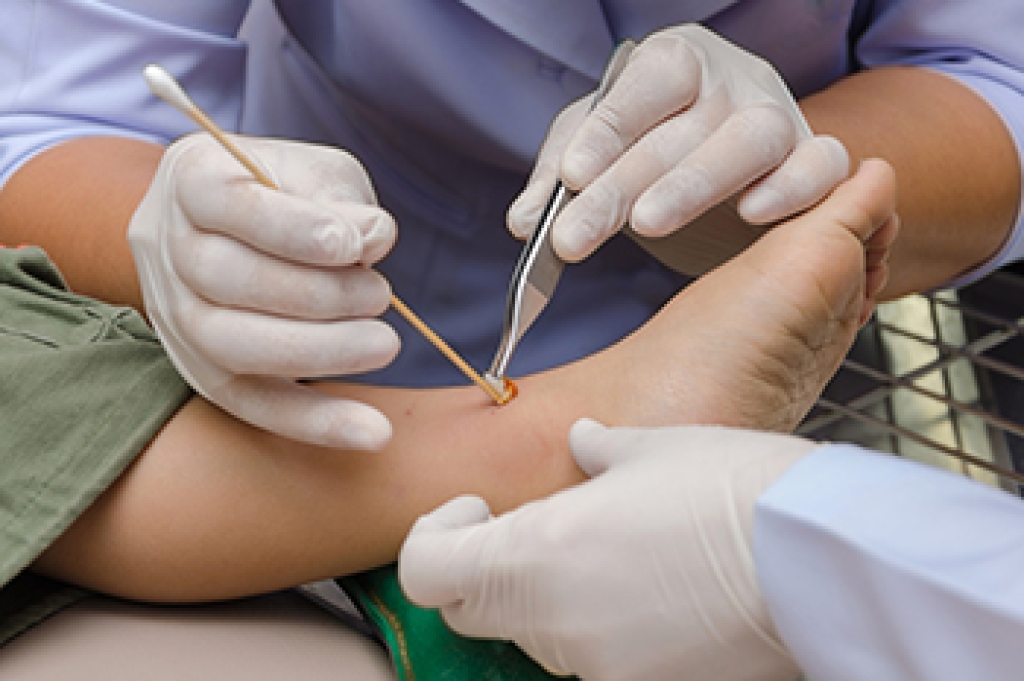
Foot infections can affect anyone, but they tend to be more complicated in people with diabetes. Even a small cut, blister, or sore can worsen quickly when blood flow or sensation is reduced. In these cases, the body may not respond as efficiently, allowing the problem to spread deeper into the skin or surrounding tissue. Compared to those without diabetes, these infections are more likely to return after treatment, require hospital care, or lead to more extensive procedures. Healing can also take longer, especially if the issue is not addressed early. For individuals without diabetes, infections still need prompt attention, but they often resolve more quickly with appropriate care. The key in all cases is early recognition and treatment. If you notice redness, swelling, warmth, drainage, or increasing pain in your foot, it is strongly suggested that you see a podiatrist for proper diagnosis and appropriate treatment, which may require wound care.
Wound care is an important part in dealing with diabetes. If you have diabetes and a foot wound or would like more information about wound care for diabetics, consult with Melissa C. Verde, DPM from Florida. Our doctor will assess your condition and provide you with quality foot and ankle treatment.
What Is Wound Care?
Wound care is the practice of taking proper care of a wound. This can range from the smallest to the largest of wounds. While everyone can benefit from proper wound care, it is much more important for diabetics. Diabetics often suffer from poor blood circulation which causes wounds to heal much slower than they would in a non-diabetic.
What Is the Importance of Wound Care?
While it may not seem apparent with small ulcers on the foot, for diabetics, any size ulcer can become infected. Diabetics often also suffer from neuropathy, or nerve loss. This means they might not even feel when they have an ulcer on their foot. If the wound becomes severely infected, amputation may be necessary. Therefore, it is of the upmost importance to properly care for any and all foot wounds.
How to Care for Wounds
The best way to care for foot wounds is to prevent them. For diabetics, this means daily inspections of the feet for any signs of abnormalities or ulcers. It is also recommended to see a podiatrist several times a year for a foot inspection. If you do have an ulcer, run the wound under water to clear dirt from the wound; then apply antibiotic ointment to the wound and cover with a bandage. Bandages should be changed daily and keeping pressure off the wound is smart. It is advised to see a podiatrist, who can keep an eye on it.
If you have any questions please contact our office located in Longwood, FL . We offer the newest diagnostic and treatment technologies for all your foot and ankle needs.

 Dr. Melissa
 Dr. Raluca